


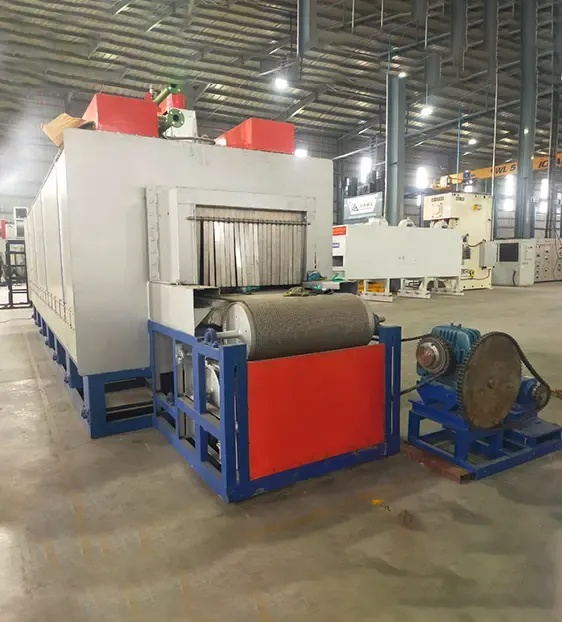
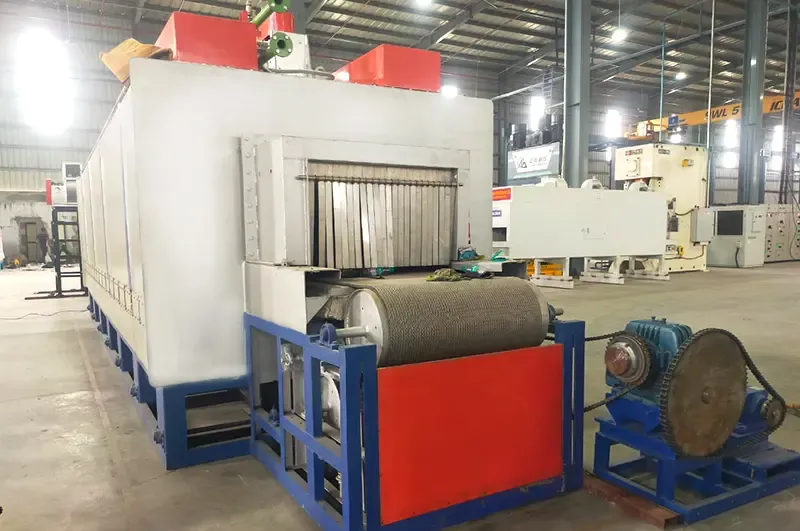
A Continuous Mesh Belt Furnace is mainly used where heating needs to happen in a continuous flow. In this system, a moving mesh belt carries the parts slowly through different heating zones. Because of this, every piece gets equal heat, which helps in getting uniform results. It is commonly used for processes like annealing, tempering, hardening, and sintering of small metal components. We are known as one of the top Continuous Mesh Belt Furnace manufacturers in India.
Technical Specifications
To Maintain The Same Temperature
Customizable based on production requirements.
50 Kgs To 1000 Kgs / Hr
Initial heating zone to gradually raise the temperature of the materials.
Zone for controlled cooling of the materials after heat treatment.
- Electric Resistance Heating: Nichrome or Kanthal heating elements provide precise and uniform heating throughout the furnace.
- Heating Control: PID temperature control system with thermocouples for accurate temperature monitoring and adjustment.
Main heating zone where the materials reach the desired temperature for the heat treatment process.
- Sensor For Conveyor Movement
- Drive System: Variable speed motor and gearbox for precise control of belt speed.
- Tensioning System: Automatic tensioning system to maintain proper belt tension and alignment.
- Mesh Belt: Made of high-temperature resistant alloy, the mesh belt carries the materials through the furnace.
- Overtemperature Protection: Safety interlocks and alarms to prevent overheating.
- Emergency Shutdown: Manual emergency stop button for immediate shutdown in case of emergencies.
- Cooling System: External cooling system to maintain safe operating temperatures of the furnace components.
Advanced Manufacturing with High-Quality Construction
Our team of engineers and technicians knows exactly how to handle the production process. We have our own factory with all the modern machines needed to build these furnaces from scratch. This helps us make sure the quality is high and the production is fast. We use the latest technology and high-quality materials to make our products. Every furnace we sell is quality checked many times to make sure it works perfectly before it reaches you. If you want a furnace that lasts long and is easy to use, our Continuous Mesh Belt Furnace is a great choice.
Find Out Features of Continuous Mesh Belt Furnace
Salient Features
- Heats every part evenly
- Saves on electricity and fuel
- Moves materials automatically
- Simple controls for easy operation
- Strong mesh belt that lasts a long time
- Built in our own modern factory
- Fast production speed
- Checked for quality many times
- Good insulation to keep heat inside
Applications of Continuous Mesh Belt Furnace
Why Our Continuous Mesh Belt Furnace Works for You
We designed it to be simple so that your operators can handle it without any trouble. It features a smart combustion system that helps save fuel and power. We focus on giving you the best quality without making the machine too complicated to run. As reliable Continuous Mesh Belt Furnace suppliers in India, we help many different industries with their heating needs. Whether you are making car parts or small metal tools, our furnace can handle the job. We make sure the belt moves smoothly and the heat stays steady throughout the day. At Maharith Thermal Pvt. Ltd., we care about making machines that help your factory run better.
Frequently Asked Questions (FAQs)
What is a continuous mesh belt furnace?
A continuous mesh belt furnace is an industrial heat treatment furnace in which components are continuously conveyed through heating, soaking, and cooling zones using a heat-resistant wire mesh conveyor belt. It is designed for high-volume production of small to medium-sized components requiring consistent and repeatable heat treatment.
Mesh belt furnaces are widely used for processes such as annealing, tempering, hardening, stress relieving, brazing, sintering, and bright heat treatment. They offer excellent temperature control, uniform heating, high productivity, and minimal manual handling, making them ideal for automated manufacturing environments.
Typical applications include automotive parts, fasteners, bearings, springs, stampings, powder metallurgy components, and general engineering products.
At Maharith Thermal Pvt. Ltd., we design and manufacture custom continuous mesh belt furnaces with advanced automation, precise temperature control, and energy-efficient operation to meet diverse industrial heat treatment requirements.
How does a continuous mesh belt furnace work?
A continuous mesh belt furnace operates by transporting components through different temperature zones on a heat-resistant mesh conveyor belt. The components enter the furnace at one end, pass through preheating, heating, soaking, and cooling zones, and exit after completing the required heat treatment cycle.
The conveyor speed is precisely controlled to ensure the correct heating and soaking time for each component. Depending on the application, the furnace may operate in air or under a controlled atmosphere to prevent oxidation and improve product quality.
Modern mesh belt furnaces are equipped with PLC-based controls, multiple heating zones, PID temperature control, and optional SCADA systems for accurate process monitoring and repeatable results.
At Maharith Thermal Pvt. Ltd., our mesh belt furnaces are engineered for reliable operation, consistent product quality, and high production efficiency.
What are the main industrial applications of a mesh belt furnace?
Continuous mesh belt furnaces are widely used in industries requiring high-volume heat treatment of small and medium-sized components.
Typical applications include:
- Automotive components
- Bearings
- Fasteners
- Springs
- Gears
- Chains
- Powder metallurgy parts
- Stampings
- Hand tools
- Electrical components
- Small forgings
- General engineering products
Common heat treatment processes include annealing, hardening, tempering, stress relieving, brazing, sintering, and bright heat treatment.
Mesh belt furnaces are particularly suitable for automated production lines where consistent quality, high throughput, and minimal manual handling are required.
At Maharith Thermal Pvt. Ltd., we manufacture custom mesh belt furnaces for a wide range of industrial applications, ensuring excellent temperature uniformity and reliable long-term performance.
What heat treatment processes can be performed in a mesh belt furnace?
A continuous mesh belt furnace can perform a variety of heat treatment processes depending on the operating temperature, furnace atmosphere, and production requirements.
Common processes include:
- Annealing
- Tempering
- Hardening
- Stress relieving
- Bright annealing
- Brazing
- Sintering
- Carbonitriding (with appropriate atmosphere)
- Preheating
- Drying and curing (low-temperature applications)
The selection of the process depends on the material grade, required mechanical properties, and production volume.
At Maharith Thermal Pvt. Ltd., our continuous mesh belt furnaces are custom-designed to deliver consistent metallurgical results, precise temperature control, and high production efficiency.
What materials can be processed in a continuous mesh belt furnace?
Continuous mesh belt furnaces are suitable for processing a wide range of ferrous and non-ferrous materials, depending on the heat treatment process and furnace configuration.
Common materials include:
- Carbon steel
- Alloy steel
- Stainless steel
- Tool steel
- Cast iron
- Copper and copper alloys
- Brass
- Bronze
- Powder metallurgy components
- Selected aluminium alloys (for low-temperature applications)
The furnace operating temperature, conveyor belt material, and protective atmosphere should be selected based on the material type and the required heat treatment process.
At Maharith Thermal Pvt. Ltd., we design continuous mesh belt furnaces for a wide range of materials and applications, providing excellent temperature uniformity, process reliability, and long service life
What is the maximum operating temperature of a mesh belt furnace?
The maximum operating temperature of a continuous mesh belt furnace depends on the furnace design, heating system, conveyor belt material, and heat treatment process.
Industrial mesh belt furnaces typically operate between 200°C and 1,150°C, depending on the application and belt alloy.
Common operating temperatures include:
- Tempering: 150°C–700°C
- Annealing: 600°C–950°C
- Hardening: 800°C–950°C
- Brazing: 900°C–1,150°C
- Sintering: Application dependent
At Maharith Thermal Pvt. Ltd., we design custom mesh belt furnaces with operating temperatures tailored to the customer’s process requirements while ensuring excellent temperature uniformity and long conveyor belt life.
What are the advantages of a mesh belt furnace over a batch furnace?
A continuous mesh belt furnace is ideal for high-volume production where similar components require the same heat treatment cycle.
Key advantages include:
- Continuous, automated production.
- Higher productivity.
- Consistent heat treatment quality.
- Reduced labour and material handling.
- Lower operating cost per component.
- Better process repeatability.
- Easy integration with automated production lines.
- Improved energy efficiency during continuous operation.
For large, heavy, or low-volume components, a batch furnace is generally the preferred choice due to its greater flexibility.
At Maharith Thermal Pvt. Ltd., we help customers select the most suitable furnace based on production volume, component size, and process requirements.
How do I select the right mesh belt furnace for my application?
Selecting the right mesh belt furnace depends on several technical and production factors.
Consider the following:
- Component size and weight.
- Production capacity (parts per hour).
- Heat treatment process.
- Operating temperature.
- Required atmosphere.
- Conveyor belt material.
- Temperature uniformity requirements.
- Heating method (electric or gas-fired).
- Automation level.
- Future production expansion.
Choosing the correct furnace ensures consistent product quality, maximum productivity, and lower operating costs.
At Maharith Thermal Pvt. Ltd., our engineering team custom-designs each mesh belt furnace to match the customer’s exact production and heat treatment requirements.
What conveyor belt materials are used in a mesh belt furnace?
The conveyor belt is manufactured from high-temperature heat-resistant alloys selected according to the operating temperature, product weight, and furnace atmosphere.
Common belt materials include:
- SS304 (low-temperature applications).
- SS310 / SS310S.
- AISI 314.
- Inconel alloys.
- RA330 heat-resistant alloy.
- Other nickel-chromium heat-resistant alloys.
The belt material is selected to provide:
- High temperature strength.
- Oxidation resistance.
- Long service life.
- Resistance to thermal fatigue.
- Reliable operation under continuous production.
At Maharith Thermal Pvt. Ltd., we select the optimum conveyor belt alloy based on the customer’s process temperature, workload, and furnace atmosphere.
How much weight can a mesh belt conveyor carry?
The load capacity of a mesh belt conveyor depends on the belt width, belt design, support rollers, operating temperature, and component dimensions.
Typical capacities range from a few kilograms per metre for small precision components to several hundred kilograms per metre for heavy-duty industrial applications.
The allowable load is influenced by:
- Belt alloy.
- Operating temperature.
- Product size and shape.
- Load distribution.
- Conveyor speed.
- Support system.
Proper loading helps prevent belt deformation, excessive wear, and reduced belt life.
At Maharith Thermal Pvt. Ltd., every mesh belt conveyor is engineered to suit the customer’s production requirements, ensuring reliable operation, long belt life, and consistent heat treatment performance.
How does belt speed affect heat treatment quality?
Belt speed directly determines the heating time, soaking time, and cooling cycle of the components. If the belt moves too quickly, components may be underheated; if it moves too slowly, they may overheat, resulting in inconsistent hardness, microstructure, and product quality. Accurate belt speed control is essential for achieving uniform and repeatable heat treatment results.
At Maharith Thermal Pvt. Ltd., our mesh belt furnaces feature PLC-controlled variable speed drives for precise process control and consistent product quality.
Why are my components coming out with uneven hardness or discoloration?
Uneven hardness or discoloration is usually caused by improper temperature control, incorrect belt speed, poor atmosphere control, uneven loading, or worn heating components.
Common causes include:
- Incorrect belt speed.
- Uneven temperature distribution.
- Faulty heating elements or burners.
- Poor protective atmosphere control.
- Incorrect loading or product spacing.
- Thermocouple or controller calibration errors.
Regular maintenance, calibration, and proper process settings help ensure consistent heat treatment results.
At Maharith Thermal Pvt. Ltd., our mesh belt furnaces are designed with multi-zone heating, precise temperature control, and advanced atmosphere management for consistent product quality.
What causes mesh belt damage, and how can it be prevented?
Mesh belt damage is generally caused by excessive loading, improper belt tracking, high operating temperatures, thermal fatigue, or inadequate maintenance.
To extend belt life:
- Avoid overloading the conveyor.
- Maintain correct belt alignment and tracking.
- Operate within the recommended temperature range.
- Inspect the belt regularly for wear or damage.
- Replace worn support rollers and drive components.
- Perform preventive maintenance as recommended.
Using the correct belt alloy for the application also significantly improves service life.
At Maharith Thermal Pvt. Ltd., we use premium heat-resistant conveyor belts and provide maintenance guidance to maximize belt performance and longevity.
Can a mesh belt furnace operate with a protective atmosphere?
Yes. Continuous mesh belt furnaces can be designed to operate with a protective or controlled atmosphere to prevent oxidation, minimize decarburization, and improve surface finish during heat treatment.
Controlled atmosphere operation is commonly used for:
- Bright annealing.
- Hardening.
- Tempering.
- Brazing.
- Sintering.
- Carbonitriding.
The furnace is designed with a gas-tight chamber, atmosphere control system, and safety features to maintain the required gas composition throughout the process.
At Maharith Thermal Pvt. Ltd., we manufacture atmosphere-controlled mesh belt furnaces with advanced gas management systems for high-quality heat treatment applications.
What atmosphere gases are commonly used in a mesh belt furnace?
The choice of atmosphere gas depends on the heat treatment process, material, and required surface finish.
Common protective gases include:
- Nitrogen (N₂).
- Hydrogen (H₂).
- Nitrogen–Hydrogen mixtures.
- Endothermic gas.
- Exothermic gas.
- Argon (Ar).
- Special process gas mixtures.
These atmospheres help:
- Prevent oxidation.
- Reduce decarburization.
- Produce bright surface finishes.
- Improve process consistency.
- Enhance metallurgical properties.
At Maharith Thermal Pvt. Ltd., our continuous mesh belt furnaces are designed with reliable atmosphere control systems that ensure consistent gas composition, safe operation, and repeatable heat treatment result
Can a mesh belt furnace comply with AMS 2750 and CQI-9?
Yes. A continuous mesh belt furnace can be designed to comply with AMS 2750, CQI-9, and other customer-specific heat treatment standards when equipped with the required instrumentation, temperature control systems, and calibration procedures.
Typical compliance features include:
- Multi-zone temperature control.
- Calibrated thermocouples.
- Certified temperature controllers and recorders.
- Temperature Uniformity Survey (TUS).
- System Accuracy Test (SAT).
- Process data logging and traceability.
- PLC and SCADA integration.
- Regular calibration and preventive maintenance.
At Maharith Thermal Pvt. Ltd., we design mesh belt furnaces to meet customer-specific quality standards, ensuring consistent heat treatment performance and complete process traceability.
What is the typical operational lifespan of a mesh belt furnace?
The typical operational lifespan of a continuous mesh belt furnace is 8 to 10 years or more, depending on its design, operating conditions, production volume, and maintenance practices.
The service life depends on:
- Operating temperature.
- Conveyor belt condition.
- Heating system maintenance.
- Insulation quality.
- Preventive maintenance.
- Product loading practices.
- Atmosphere control.
Regular inspection and timely replacement of wear components such as mesh belts, heating elements, thermocouples, rollers, bearings, and drive components help maximize furnace life.
At Maharith Thermal Pvt. Ltd., our mesh belt furnaces are manufactured using high-quality materials and engineered for long-term, reliable industrial operation.
How much does an industrial mesh belt furnace cost?
The cost of a continuous mesh belt furnace depends on several factors, including furnace size, operating temperature, conveyor width, production capacity, heating method, atmosphere requirements, automation level, and customer specifications.
The main cost factors include:
- Conveyor width and length.
- Production capacity.
- Maximum operating temperature.
- Electric or gas-fired heating.
- Protective atmosphere system.
- PLC, HMI, and SCADA requirements.
- Cooling system.
- Material handling integration.
- Applicable industry standards.
At Maharith Thermal Pvt. Ltd., every mesh belt furnace is custom-designed to meet the customer’s production and heat treatment requirements. Contact our engineering team with your process details for a detailed techno-commercial proposal.
What maintenance does a continuous mesh belt furnace require?
Regular preventive maintenance ensures reliable operation, consistent product quality, and extended equipment life.
A typical maintenance schedule includes:
Daily
- Inspect the mesh belt and conveyor drive.
- Check temperature readings and alarms.
- Verify atmosphere flow (where applicable).
Monthly
- Inspect heating elements or burners.
- Check belt alignment and tracking.
- Inspect thermocouples and electrical connections.
Quarterly
- Inspect insulation and conveyor rollers.
- Verify controller calibration.
- Check drive motors and gearboxes.
Annually
- Perform complete preventive maintenance.
- Replace worn conveyor components if required.
- Calibrate temperature instruments.
- Verify furnace performance.
At Maharith Thermal Pvt. Ltd., we offer preventive maintenance, calibration services, Annual Maintenance Contracts (AMC), spare parts, and technical support to maximize furnace reliability and minimize downtime.
What should I consider before buying a continuous mesh belt furnace?
Selecting the right continuous mesh belt furnace is essential for achieving high productivity, consistent heat treatment quality, and low operating costs.
Before purchasing, consider:
- Component size and weight.
- Production capacity.
- Heat treatment process.
- Maximum operating temperature.
- Conveyor belt width and speed.
- Electric or gas-fired heating.
- Protective atmosphere requirements.
- Temperature uniformity.
- Automation level (PLC, HMI, SCADA).
- Available floor space and utilities.
- Energy efficiency.
- After-sales service and spare parts availability.
Choosing a furnace from an experienced manufacturer ensures long-term reliability, consistent product quality, and lower operating costs.
At Maharith Thermal Pvt. Ltd., we design and manufacture custom continuous mesh belt furnaces tailored to each customer’s application. From engineering and manufacturing to installation, commissioning, training, and after-sales support, we deliver complete heat treatment solutions for modern industrial production.
What causes parts to fall through the mesh belt during processing?
Parts may fall through the mesh belt if they are smaller than the belt openings, improperly loaded, or if the belt is damaged or worn. Selecting the correct mesh size and ensuring proper loading helps prevent product loss and maintain smooth operation
How is mesh belt tension managed and what happens if it's wrong?
Mesh belt tension is adjusted using the belt tensioning system to ensure smooth and stable conveyor operation. Incorrect belt tension can cause belt misalignment, excessive wear, slippage, or premature belt failure, affecting production and heat treatment quality
What happens to the belt when the furnace is shut down and restarted frequently?
Frequent furnace shutdowns and restarts can cause thermal fatigue, belt distortion, reduced belt life, and increased wear due to repeated heating and cooling cycles. Proper operating practices help maximize conveyor belt life and maintain reliable performance
Any Enquiry
If you’ve got questions or ideas you would like to share, send a message. For anything more specific, please use one of the addresses listed below.
Old No. 2/73, New No. 3/849, Bye Pass Road, Devi Kalyana Madnadapam Complex, Sennerkuppam, Poonamallee Chennai, Tamil Nadu, India – 600056
+91-9444063455