


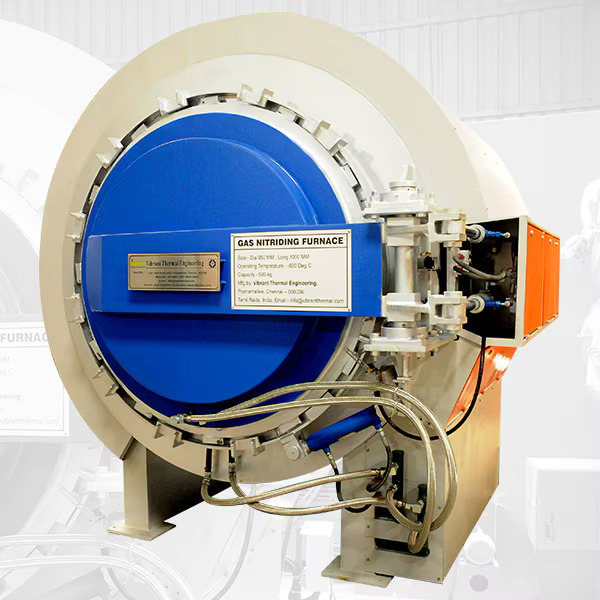
We recognize that the process of diffusing the nitrogen to the surface of a ferrous is known as nitriding. The process will raise the hardness of the surface, wear, abrasion resistance, corrosion resistance, and fatigue strength. Maharith Thermal Pvt. Ltd. has been working for many years in the industry for batch and continuous equipment. We manufacture the gas nitriding furnace a type of batch furnace that can be used for ammonia-related processes. The furnace will be handy for the works in the auto parts, gears, tool, die, plastics, aluminium extrusion, casting, military industry, and more.
Technical Specifications
Indirect gas-fired heating system (typically natural gas or propane)
400°C to 580°C (typical, can vary depending on application)
Controlled nitriding atmosphere with precise ammonia dissociation and control system
Can be customized as per client’s needs.
High-temperature, energy-efficient insulation materials
Electrically operated lifting or lowering door for safety and ease of use
Can be customized as per client’s needs.
- Flame safeguard system
- Low gas pressure safety cut-off
- Interlocked door and lifting mechanism
- Excess furnace temperature protection with alarm and cut-off
Reliable Gas Nitriding Furnace that Lasts Long
Being a top gas nitriding furnace manufacturers in India, we know that there is always a requirement for hard surfaces that have a long life. With us, you can rely on our products to take the maximum life off them. The product won’t require a replacement period below 10 years.
It won’t cause any issues with the temperature as it is equipped with a temperature ranging feature that keeps the temperature in-between 150 to 700 degree centigrade.
Find Out Features of Gas Nitriding Furnace
Applications of Gas Nitriding Furnace
Growing a Business is Easy with Top-Notch Gas Nitriding Furnace
The product of top Gas Nitriding Furnace Suppliers In India will be of sturdy quality like stainless steel, multiple swinging material frames, heating unit, warm control cabinet, stainless steel fast cold box that will run automatically with a touch of a button so your material hardening task can be at a quickest time time possible. The multiple heating control zones installed in it will let you set up the specific temperature in the furnace as per the work requirements for unique product manufacturing.
Frequently Asked Questions (FAQs)
What is the process of gas nitriding?
How long does gas nitriding take?
What is the temperature of gas nitriding?
What are the Nitriding Benefits?
What is the difference between gas nitriding and liquid nitriding?
What is the maximum hardness of the nitride?
What is the heating method for nitriding?
Can you remove nitriding?
Any Enquiry
If you’ve got questions or ideas you would like to share, send a message. For anything more specific, please use one of the addresses listed below.
Old No. 2/73, New No. 3/849, Bye Pass Road, Devi Kalyana Madnadapam Complex, Sennerkuppam, Poonamallee Chennai, Tamil Nadu, India – 600056
+91-9444063455