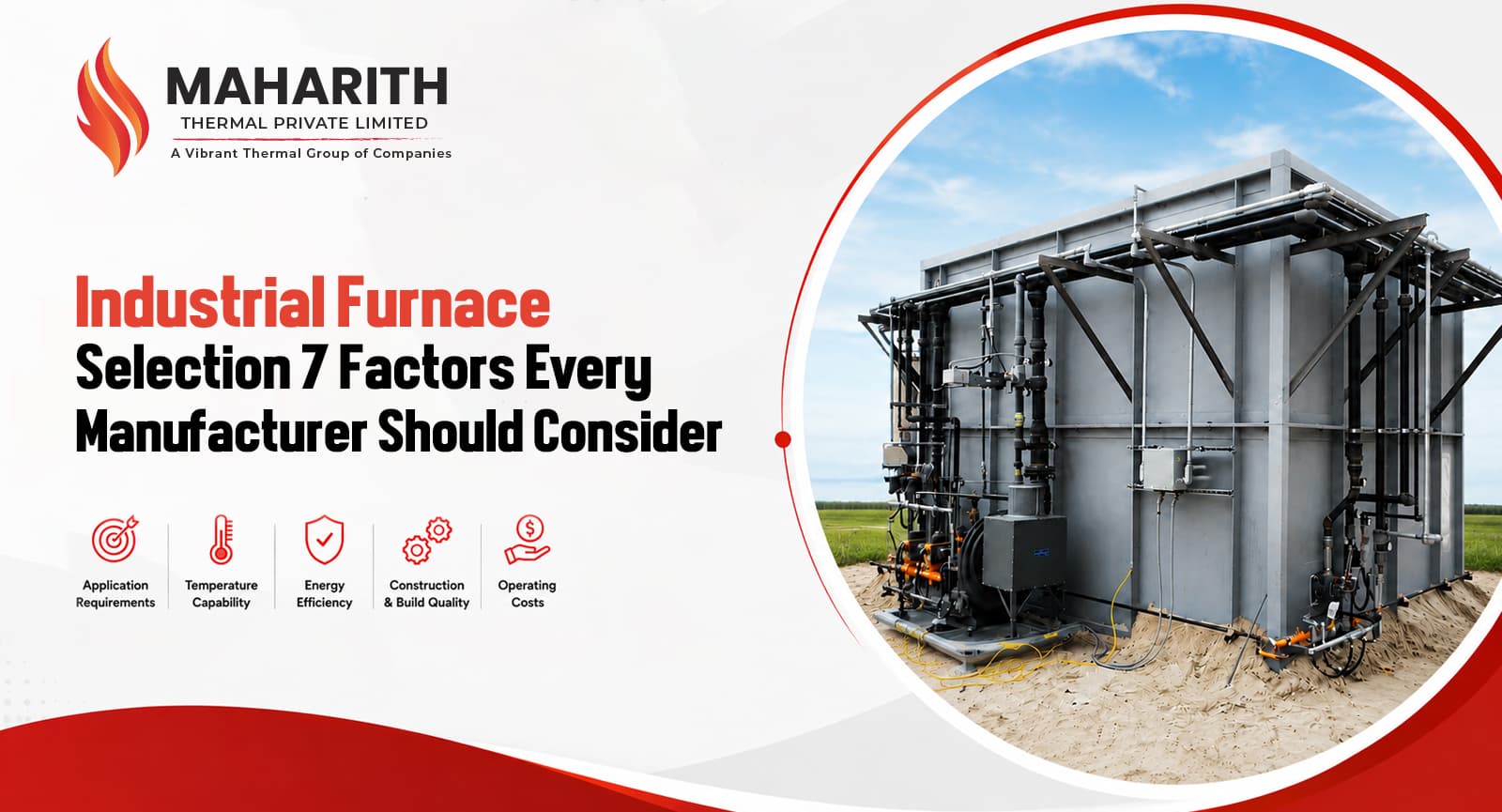
Overview – Buying an industrial furnace without checking the right factors leads to a machine that either cannot do the job or does it inefficiently for years. Most manufacturers know what process they need. Fewer know which factors to check before committing to a specification.
This blog covers:
Introduction
An industrial furnace sits at the center of heat treatment, annealing, hardening, tempering, and dozens of other critical processes. Get the selection right, and it runs reliably for years. Get it wrong and you are either replacing it early or working around its limitations every production cycle.
These seven factors are what experienced industrial furnace manufacturers ask about before recommending anything.
1. Temperature Range and Process Requirements
Confirm the temperature your process actually needs, then add headroom above it. Maharith Thermal’s industrial furnaces go up to 1200°C, covering most heat treatment applications. Common reference points:
- Annealing aluminium: 300°C to 500°C
- Hardening tool steels: 900°C to 1100°C
- Sintering ceramics: above 1200°C
Also confirm the heat-up rate. Some processes need to reach temperature quickly. Others need a gradual ramp to avoid thermal shock. The furnace needs to handle both.
2. Heating Method — Electric, Gas, or Hybrid
Quality makers supply electric, gas-fired, oil-fired, and hybrid configurations. The right choice depends on energy supply, process requirements, and operating cost:
- Electric — tighter temperature control, cleaner atmosphere, lower maintenance. Suits processes where atmospheric purity matters. Higher operating cost where electricity is expensive.
- Gas-fired — more economical at higher temperatures and larger capacities. Faster heat-up, better suited to high-throughput operations. Not appropriate for processes needing a controlled atmosphere.
- Hybrid—gas for primary heating, electric for fine temperature control during the soak period.
3. Industrial Furnace Chamber Size and Loading Capacity
Maharith Thermal provides loading capacities from less than 500 kg to 3000 to 5000 kg with chamber sizes tailored to customer requirements.
Key takeaways:
- Chamber should accommodate the largest piece or batch with clearance around the load for heat circulation
- Running a furnace at full load all the time shortens the life of heating element and structural parts
- If the batch size is highly variable, two smaller furnaces may be more efficient than one large furnace operating at partial capacity.
4. Batch Versus Continuous Processing
- Batch furnaces — box, bell, bogie hearth, pit type. Load a fixed quantity, run the cycle, unload, repeat. Suit varied component types, different alloys, and lower-volume production where flexibility matters.
- Continuous furnaces — mesh belt, conveyor, shaker hearth. Components move through a heated zone continuously. Suit high-volume production of similar components running the same cycle repeatedly.
Maharith Thermal manufactures both. The choice comes down to throughput volume and how often process parameters change.
5. Atmosphere Control Requirements
Processes like bright annealing, gas nitriding, and controlled atmosphere hardening require a specific gas environment — hydrogen, nitrogen, endothermic gas, or ammonia. If your process requires this:
- The furnace needs to be sealed with gas inlet and outlet connections
- Controls must manage atmosphere composition throughout the cycle
- Safety systems for the gases involved are part of the specification
If your process runs in air—normalizing, stress relieving, or general annealing—atmosphere control is not required.
6. Temperature Uniformity and Control Systems
Poor uniformity produces variation in hardness, case depth, or material properties across the batch even when the controller reads on target. Maharith Thermal’s furnaces use PID controllers with thermocouple feedback and programmable temperature profiles. For tighter requirements:
- Multiple temperature zones, each with their own thermocouple, give better uniformity than a single-zone system
- AMS 2750 specifies temperature uniformity requirements for aerospace applications—confirm the furnace meets the required class before ordering
7. Material and Construction Quality
- Refractory lining — ceramic fibre heats and cools faster than brick, reduces energy loss per cycle
- Heating elements — Maharith Thermal uses coil, rod, strip, and bundle rod types depending on temperature range. Element material determines service life.
- Structural materials — cast iron, mild steel, and stainless steel used across components depending on temperature exposure
- Build standard—Maharith Thermal is ISO 9001:2015 certified and TUV approved
Speak to the Maharith thermal team
Maharith Thermal Pvt. Ltd., based in Chennai, is one of the established manufacturers of industrial furnaces in India. We supply batch, continuous, bell and atmosphere furnaces to the automotive, aerospace, defence, forging and heat treatment industries. Contact us at +91-9444063455 or [email protected].
Frequently Asked Questions
What is the maximum temperature Maharith Thermal's industrial furnaces reach?
Up to 1200°C as standard, covering hardening, annealing, tempering, normalising, and sintering. Higher temperature configurations are available for specific applications.
Can the same industrial furnace handle multiple heat treatment processes?
Yes, if specified correctly. Programmable temperature profiles allow different cycles to be run on the same furnace. The limit is when processes require incompatible atmospheres or temperatures outside the design range.
How do I choose between batch and continuous?
Batch suits varied production with different component types. Continuous suits high-volume production running the same cycle re peatedly.
Is customisation available?
Yes. Chamber dimensions, loading capacity, heating method, atmosphere control, and control system configuration can all be adjusted. Most industrial applications benefit from some degree of customisation.