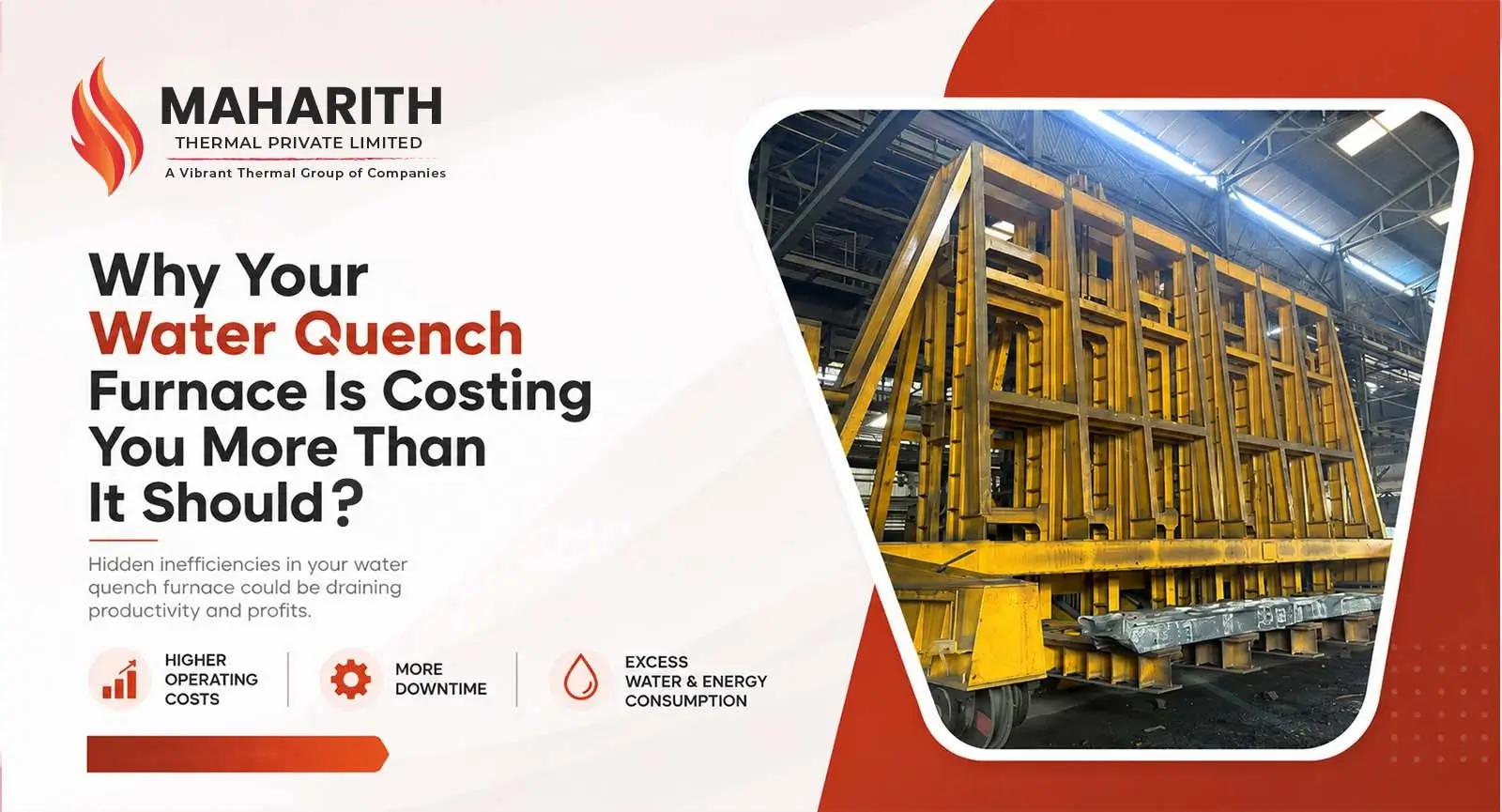
If your heat treatment shop runs a water quench furnace, you already know it is one of the heavy-duty equipment on the floor. But here is the thing — a furnace that keeps running does not necessarily mean it is running efficiently. Many industries unknowingly spend extra costs every month on their furnace operations than necessary. Rising energy bills, inconsistent hardness results, frequent component replacements — these are often symptoms of low efficiency of the furnace. This blog breaks down where that hidden cost actually comes from and what can be done about it.
What is a Water Quench Furnace?
A water quenching furnace is a heat treatment furnace used to harden metal components. The part is heated to a specific temperature — high enough to change its internal grain structure — and then rapidly cooled by immersing or spraying it with water. This rapid cooling, or quenching, locks in the hardened structure, giving the metal the strength and wear resistance needed for its application.
Water quenching is one of the most aggressive cooling methods used in heat treatment, which makes it suitable for steels and alloys that need high hardness. But that aggressiveness is also exactly why poor furnace design or operation creates problems — both in product quality and in operating costs.
The Hidden Costs Most Plants Do Not Notice
When people think about water quench furnace costs, they usually think about the electricity or fuel bill. That is just the most visible part of a much bigger picture.
Here is where the real costs often hide:
- Uneven heating leading to rework — If the furnace does not heat components uniformly, some parts come out under-hardened and need to be reprocessed, doubling the energy cost for those pieces
- Inconsistent quenching results — Variation in water temperature, flow rate, or agitation across the quench tank means some parts harden properly while others do not, leading to quality rejections
- Excessive cycle times — A furnace that takes longer than necessary to reach temperature or recover between cycles directly reduces how many components you can process per shift
- Frequent refractory and component repairs — Poor design or operating practices accelerate wear on furnace linings, heating elements, and quench tank components, leading to repair costs that add up over a year
- Water and chemical treatment costs — Quench water needs proper treatment and maintenance. Neglecting this leads to corrosion, contamination, and inconsistent quenching performance — all of which cost money to fix later
None of these show up as a single line item that says “furnace inefficiency.” They show up scattered across energy bills, scrap reports, maintenance budgets, and quality complaints — which is exactly why they go unnoticed for so long.
Why Older or Poorly Designed Furnaces Cost More Over Time?
A water quench furnace that was efficient when it was installed ten or fifteen years ago is not necessarily efficient today — and not just because of age.
A few reasons older furnaces tend to cost more to run:
- Insulation degrades over time — Refractory materials lose their insulating properties with age and repeated thermal cycling, meaning more energy is needed to maintain the same temperature
- Heating elements lose efficiency — Older heating elements often need to draw more power to deliver the same heat output as they did when new
- Quench systems were not designed for current production volumes — A quench tank sized for lower volumes years ago may now be running at or beyond its design capacity, leading to inconsistent results
- Control systems lack precision — Older temperature control systems often have wider tolerance bands, meaning the furnace runs hotter than necessary just to ensure parts reach minimum temperature
- Automation gaps increase labour dependency — Manual loading, unloading, and monitoring processes that were standard years ago now represent unnecessary labour costs compared to automated alternatives
The honest answer for many plants is that the furnace itself has not become less efficient overnight — it has simply fallen behind what is now achievable with better design, better controls, and better materials.
What a Well-Designed Water Quench Furnace Should Deliver?
When evaluating your current furnace — or looking at options from water quenching furnace manufacturers — these are the things that genuinely affect your operating costs:
Uniform Temperature Distribution
Proper burner or heating element placement, along with good air circulation design, ensures every component in the furnace reaches the target temperature evenly. This reduces rework and improves consistency batch after batch.
Controlled Quench Tank Design
The quench tank should maintain consistent water temperature, flow rate, and agitation across the entire tank — not just near the inlet. Poor agitation design is one of the most common causes of inconsistent hardness results.
Efficient Insulation
Modern insulation materials retain heat far better than older refractory designs, which directly reduces fuel or power consumption for the same production output.
Precise Temperature Control
Tighter control tolerances mean the furnace does not need to run hotter than necessary “just in case.” Over time, this adds up to meaningful energy savings.
Proper Water Treatment Integration
A well-designed system includes provisions for water filtration, cooling, and chemical treatment — extending the life of both the quench water and the tank components.
Signs It Might Be Time to Re-Evaluate Your Furnace
It is not always obvious that a furnace is costing more than it should. A few signs worth paying attention to:
- Energy bills have been rising steadily without a corresponding increase in production volume
- Quality rejections related to hardness or surface defects have become more frequent
- Maintenance teams are dealing with the same repairs repeatedly — refractory cracks, element failures, tank leaks
- Cycle times have crept up over time without anyone deciding they should
- Operators are compensating for inconsistent results through manual adjustments and extra checks
If two or more of these sound familiar, it is worth taking a closer look at whether the furnace is genuinely matched to current production needs — or whether it has simply been kept running because replacing it feels like a bigger decision than it actually is.
What to Look for When Buying a Water Quench Furnace?
For plants considering a new furnace — whether replacing an old unit or adding capacity — a few practical points make a real difference:
- Match the furnace size to actual production volume, not just current load, but expected growth as well
- Ask for documented temperature uniformity data, not just claimed specifications
- Check quench tank design details — agitation method, water treatment provisions, and tank capacity relative to production rate
- Confirm after-sales support and spare parts availability, since heating elements and refractory components will eventually need replacement
- Look at energy consumption figures from existing installations, not just theoretical numbers
A furnace that costs slightly more upfront but is designed properly for your application will almost always cost less over its operating life than a cheaper unit that needs constant attention.
Partner with Maharith Thermal Pvt Ltd
Looking for a water quench furnace built around your actual production needs — not just a standard catalogue size? Maharith Thermal Pvt. Ltd. designs and manufactures heat treatment furnaces, including water quench systems, engineered for consistent results and lower long-term operating costs. Whether you are replacing an old furnace or planning a new line, our team can help you specify a system that actually fits your process.
Frequently Asked Questions
What is a water quench furnace used for?
A water quenching furnace is used in heat treatment processes where metal components need to be rapidly cooled after reaching a specific temperature. The fast cooling changes the microstructure of the metal, increasing hardness and strength. It’s widely used in steel processing, automotive component manufacturing, forging, and TMT bar production.
Why does my water quench furnace produce inconsistent hardness results?
Inconsistent hardness usually points to one of three things — uneven temperature distribution inside the heating chamber, incorrect or variable quench water temperature, or inconsistent water flow rate during quenching. Each of these can be identified through proper monitoring and addressed without major equipment changes.
How often should quench water be changed or treated?
This depends on production volume and the materials being processed. As a general guideline, water quality should be tested monthly. Full replacement or treatment intervals vary, but allowing water to degrade significantly affects cooling efficiency and increases the risk of component surface defects.
What is the difference between water quenching and oil quenching?
Water quenching cools metal faster than oil, making it suitable for carbon steels and applications requiring high hardness. Oil quenching is slower and reduces the risk of cracking in more sensitive alloy steels. The right choice depends on the material grade and the mechanical properties required in the finished component.
Can a water quench furnace be customised for specific applications?
Yes. Reputable water quenching furnace manufacturers offer custom configurations covering chamber size, heating element type, quench system design, temperature control accuracy, and automation level. A furnace built to match the actual application performs significantly better than a standard unit adapted to fit.
What maintenance does a water quench furnace require?
Routine maintenance includes inspecting refractory lining for cracks, checking heating elements for wear, monitoring quench tank water quality and agitation system performance, and verifying temperature control calibration. A consistent maintenance schedule reduces unplanned downtime and helps maintain quality consistency.
What causes cracking in components after water quenching?
Cracking after quenching is usually caused by too-rapid cooling of a material that isn’t suited to water quenching, quench water that’s too cold, or thermal gradients across the component during cooling. Material selection, furnace parameters, and quench water temperature all need to be matched to the specific component and steel grade.
How do I know if my water quench furnace needs replacing or just upgrading?
If the core structure — the furnace shell, chamber dimensions, and quench tank — are in good condition, upgrading the control system, heating elements, insulation, and quench circulation system is usually more cost-effective than full replacement. A proper technical assessment from an experienced manufacturer gives a clear answer based on actual condition rather than assumptions.